2 "Linear Algebra" Posts

How Large Language Models (LLMs) Think: Turning Meaning into Math

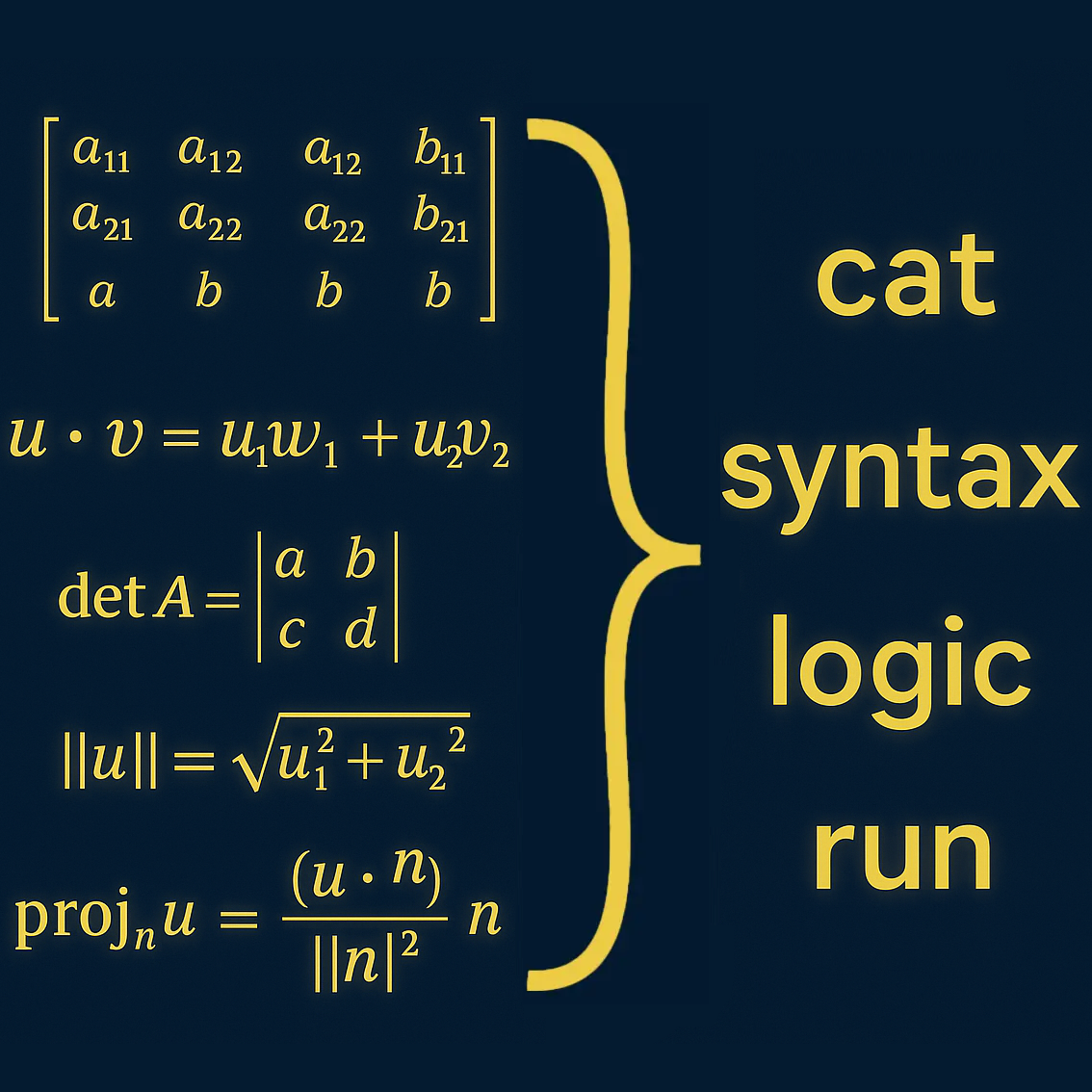
When you enter a sentence into a Large Language Model (LLM) such as ChatGPT or Claude , the model does not process words as language. It represents them as numbers.

Each word, phrase, and code token becomes a vector — a list of real-valued coordinates within a high-dimensional space. Relationships between meanings are captured not by grammar or logic but by geometry. The closer two vectors lie, the more similar their semantic roles appear to the model.

This is the mathematical foundation of large language models: linear algebra. Matrix multiplication, vector projection, cosine similarity, and normalization define how the model navigates this vast space of meaning. What feels like understanding is actually the alignment of high-dimensional vectors governed by probability and geometry.


“Linear algebra and geometry do more than support AI; they create its language of meaning.”

Read more →

Using SymPy in Python When NumPy Isn't Enough

Most of us reach for NumPy whenever math shows up in a project. But sometimes, you don’t want approximate answers, you want exact math. That’s when you pull SymPy out of your programmer’s toolkit and get to work.

It’s easy to think of SymPy only in academic terms, like running physics simulations where small rounding errors can snowball into nonsense, or checking algebraic identities where a value such as 0.0000001 should really be treated as exactly 0. Those are valid use cases, but they barely scratch the surface.

In real-world business applications, imprecision can be just as costly. Financial software is the most obvious example, where a few pennies lost to rounding errors can add up to millions at scale. Supply chain and logistics systems can also suffer when tolerances or unit conversions drift slightly off, leading to incorrect shipments or mismatched inventory. Even common scenarios such as pricing models or tax calculations can go sideways if the math behind them is not exact.


“Floats guess. SymPy knows.”


This is where SymPy shines. To see the difference between floating-point approximations (Python or NumPy) and symbolic precision (SymPy), let’s look at a simple but very real example from finance.

Read more →