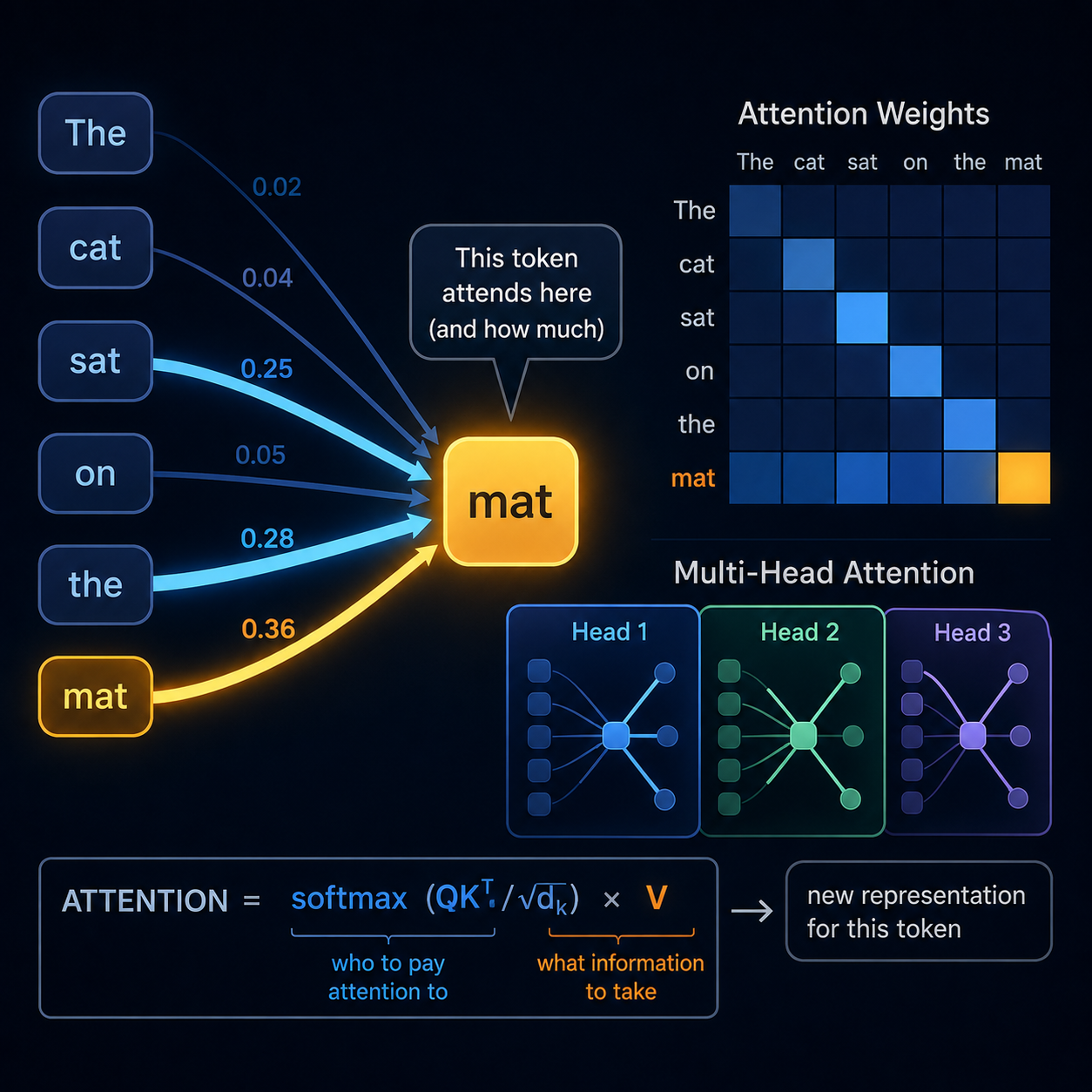
The transformer architecture is composed of many repeating transformer layers, or blocks. Each block contains an attention sublayer followed by a feedforward sublayer, wrapped in residual connections and layer normalization. Positional information is added to the input so the model knows what order the tokens came in. The attention sublayer sets the table for the feedforward sublayer: it does the work of looking at other tokens and deciding what information to absorb from them. Get attention wrong and the rest of the architecture has nothing useful to operate on.
This post is the first of a three-part series on the attention mechanism. Part 1 covers scaled dot-product attention, why we divide by \(\sqrt{d_k}\), multi-head attention, and what interpretability research has revealed about the patterns and circuits attention can learn. Part 2 covers masking and the function class it forces the model into, including how causal masking turns self-attention into the foundation of autoregressive next-token prediction. Part 3 covers the engineering layer: KV caching, multi-query and grouped-query attention, sliding window attention, and Flash Attention.
The 2017 paper, Attention Is All You Need is the seed of this series. The mechanism it described is small and elegant enough to fit on a page. Everything since has been the tree growing out of it: the core mathematics has held up, while the deployed system has acquired layers the paper did not anticipate. Part 1 stays close to the seed. Parts 2 and 3 walk the branches.
“Attention is the engine. The rest of the transformer architecture stabilizes it, organizes it, and makes deep training possible.”