
Learning Path: How LLMs Learn and Acquire Capabilities

Where do model capabilities come from?

Trace how a model goes from untrained parameters to capabilities that emerge during training and inference. This path connects gradient descent and loss functions to pre-training, post-training, scaling, in-context learning, and test-time compute, showing the different ways modern models acquire or express capabilities.

Level: Foundational → Advanced

Step 1 of 7

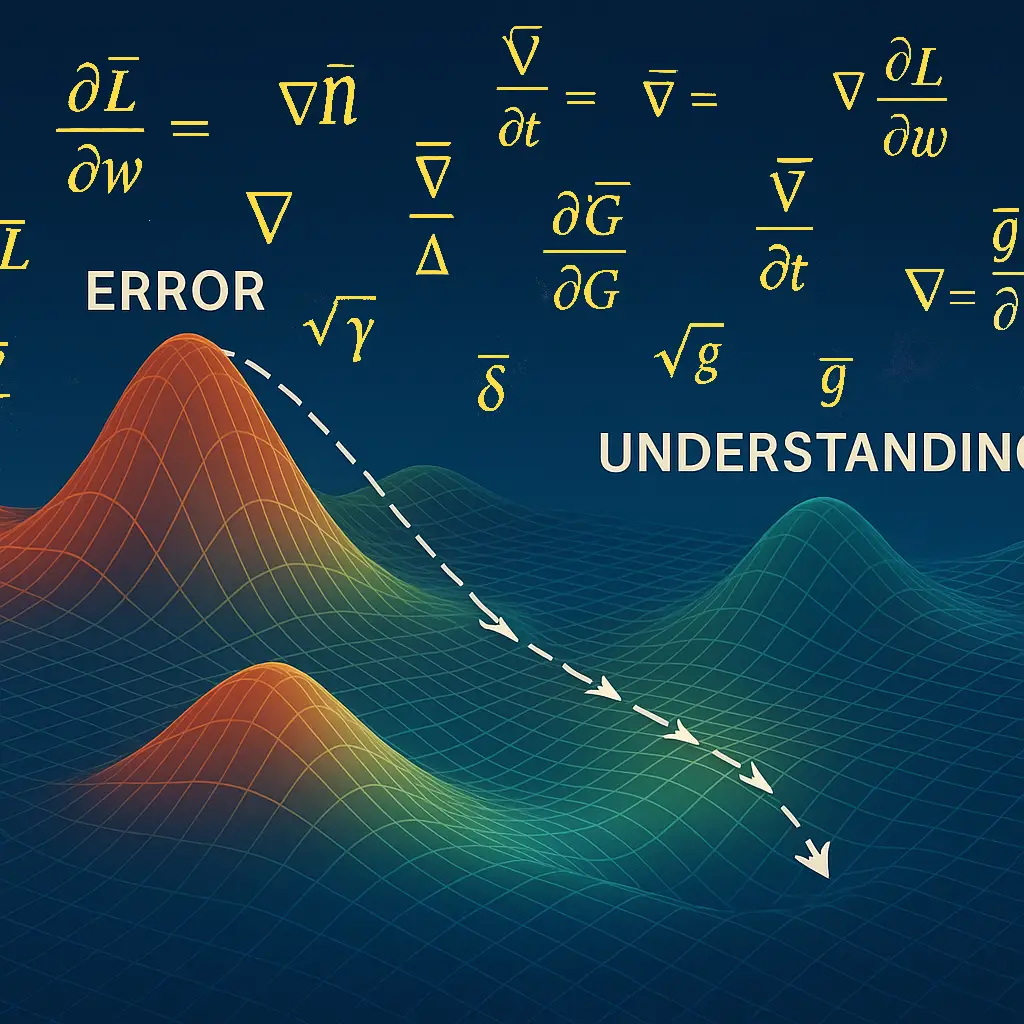
How Large Language Models (LLMs) Learn: Calculus and the Search for Understanding

Exploring how gradient descent and partial derivatives teach models to think
What You'll Learn
  • How derivatives tell a model which direction will reduce its prediction error
  • How gradient descent turns billions of small corrections into learning
  • How backpropagation uses the chain rule to assign error across many layers
  • Why the learning rate controls the balance between fast progress and stable training
  • Why noisy mini-batch updates can help a model generalize instead of memorize
  • How transformers keep gradients stable while learning which patterns deserve attention
Step 2 of 7

Softmax and Cross-Entropy Loss

○ Planned

A focused post on the connective tissue between probability and learning. Softmax as the operation that turns real numbers into distributions; cross-entropy as the loss that measures how well those distributions match the truth. Short, foundational, unlocks the probability layer.

Step 3 of 7

Pre-training vs. Post-training

○ Planned

The distinction between the compute-heavy foundation training phase and the alignment phase that shapes model behavior (supervised fine-tuning, RLHF, DPO, Constitutional AI). One of the highest-confusion topics for readers new to the field and a natural companion to the cooperative witness piece.

Step 4 of 7

Scaling Laws and Emergence

○ Planned

The empirical relationships between compute, data, parameters, and capability, and where the sharp transitions in behavior come from.

Step 5 of 7

In-Context Learning

○ Planned

How models adapt to patterns within a single prompt without parameter updates, and why induction heads (covered in Inside Attention Part 1) are part but not all of the mechanistic story.

Step 6 of 7

Reasoning Models and Test-Time Compute

○ Planned

The class of models that spend additional compute at inference time to improve their answers, and why this changes what 'capability' means.

Step 7 of 7

A Mechanistic Interpretability Primer

○ Planned

An introduction to the research program of reverse-engineering trained transformers, at the level of concrete circuits and features rather than high-level intuitions.