

Learning Path: AI for Software Engineers

What do I need to know to engineer systems with LLMs?

Build the mental models needed to design software around LLMs rather than treating the model as an ordinary API. This path focuses on how models interpret code, the constraints imposed by context windows, techniques for managing context, in-context learning, and inference-time reasoning—concepts that directly affect the reliability, cost, and architecture of production AI systems.

Level: Foundational → Advanced

Step 1 of 5

How Large Language Models (LLMs) Read Code: Seeing Patterns Instead of Logic

Exploring how large language models interpret code and what they miss
What You'll Learn
  • How an LLM reads code differently from a compiler or a human developer
  • Why models recognize programming patterns instead of executing the code they see
  • How embeddings let an LLM associate code with similar structures and meanings
  • Why comments, variable names, and familiar coding idioms can change a model’s interpretation
  • How statistically likely code can still be logically or operationally wrong
  • Why combining generative AI with compilers and static analysis produces safer coding tools
Step 2 of 5

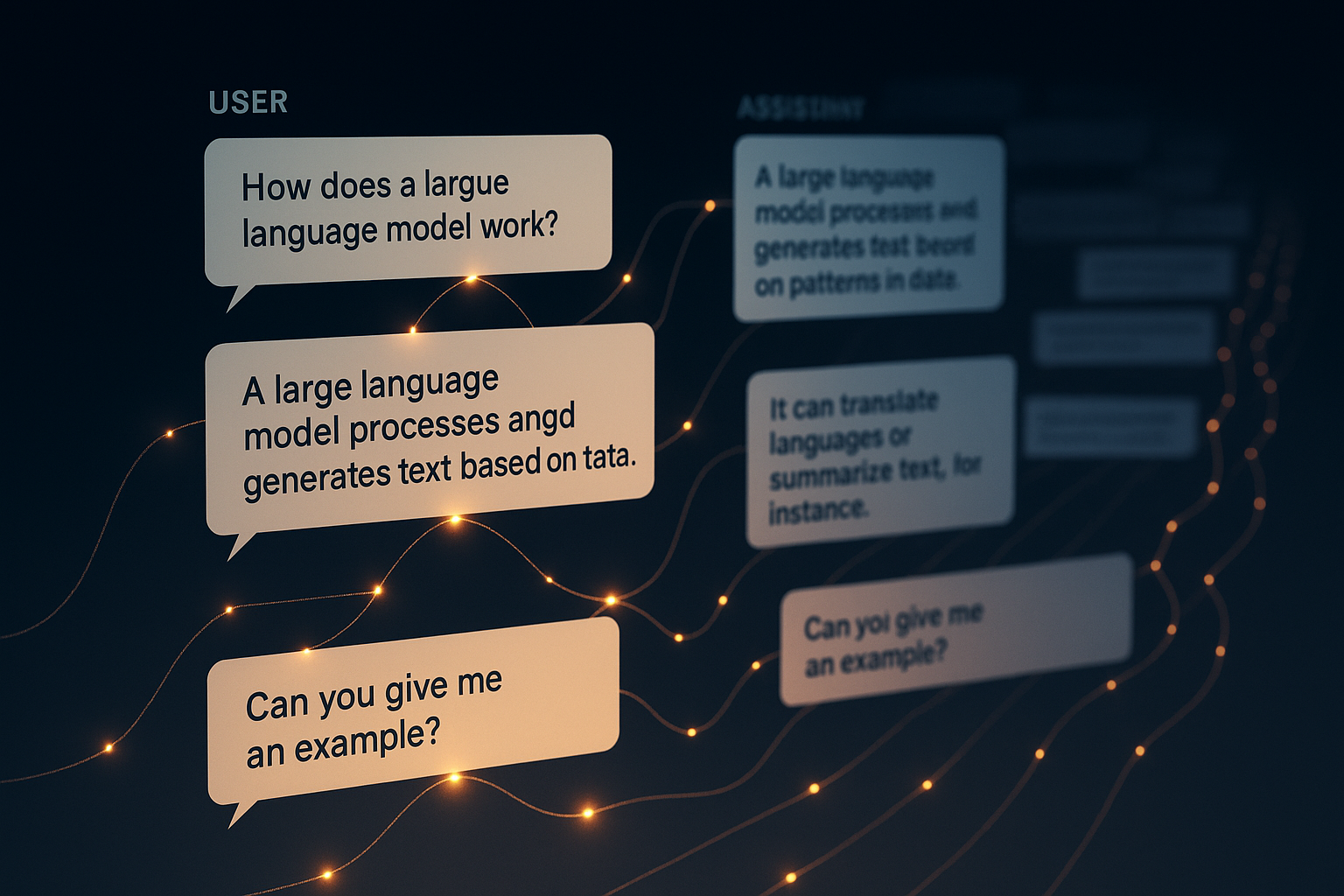
How Large Language Models (LLMs) Handle Context Windows: The Memory That Isn't Memory

Exploring why longer context doesn't mean better memory and what happens when conversations grow
What You'll Learn
  • Why an LLM’s context window is not the same thing as memory
  • How chat applications create continuity even though the underlying model is stateless
  • How attention lets earlier parts of a conversation influence the next token
  • Why longer conversations become increasingly expensive for a transformer to process
  • Why information can become harder to use even while it remains inside the context window
  • How truncation, summarization, retrieval, and KV caching help manage long conversations
Step 3 of 5

Context Compression: What Does 'Lossless' Really Mean?

○ Planned

As context windows fill, AI systems increasingly rely on summarization and compression to preserve what matters. But if a system must decide what to discard before it knows what will matter later, how “lossless” can that compression really be? An examination of what context compression preserves, what it inevitably risks losing, and why the distinction matters for long-running AI systems.

Step 4 of 5

In-Context Learning

○ Planned

How models adapt to patterns within a single prompt without parameter updates, and why induction heads (covered in Inside Attention Part 1) are part but not all of the mechanistic story.

Step 5 of 5

Reasoning Models and Test-Time Compute

○ Planned

The class of models that spend additional compute at inference time to improve their answers, and why this changes what 'capability' means.